

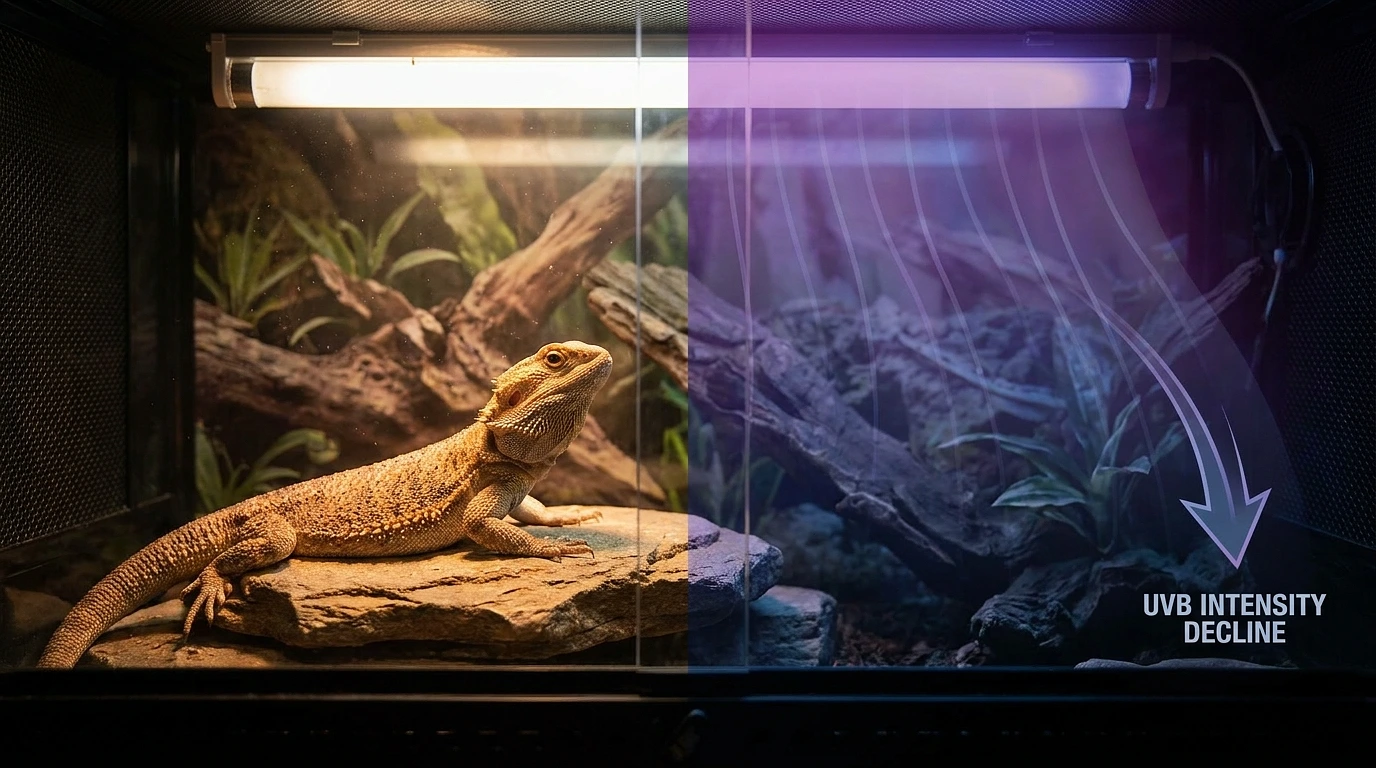
A reptile UVB bulb does not announce its own death. It keeps glowing, the enclosure stays bright, nothing looks different, and the animal underneath it is slowly losing the ability to absorb calcium. This is the most common husbandry failure in bearded dragon keeping, and it happens to careful keepers as often as careless ones.
The reason is simple physics that nobody sees. Reptile UVB bulbs gradually lose their ability to produce usable ultraviolet light over time, and because UVB is invisible to human eyes, the bulb may still look like it is functioning while its output has already declined significantly.
Brightness tells you nothing. That single fact is the whole problem.
What Is Actually Happening Inside the Tube
The decay is mechanical, not a defect. Mercury within the lamp gradually vaporises and reduces its ability to produce UVB. Deposits form on the inner surface of the arc tube and obstruct output. The electrodes at each end deteriorate and affect the electrical discharge that generates UVB in the first place.
Visible light production survives all three of those processes far longer than UVB production does. So the failure mode is invisible by design.
The decay is also front-loaded. Research on bulb output found that the majority of the decline happens during the first three months after the initial peak, with that peak measured after roughly 100 hours of burn-in. The bulb you consider still fairly new at month four has already done most of its falling.
The Replacement Intervals That Matter
Bulb type changes the answer, and the difference is not small.
- T5 HO fluorescent tubes are generally rated for around 12 months. Decay is gradual in high-quality brands and many will provide adequate levels for approximately one year
- T8 fluorescent tubes need replacing sooner, because output declines faster than T5. Six months is the common figure
- Mercury vapour and metal halide lamps run on hours rather than months, with replacement recommended after a total exposure time of approximately 3,500 operating hours
The blunt version, without a meter: replace every 12 months regardless of whether the bulb still produces visible light. A bulb running for a year may look perfectly fine while producing little to no usable UVB.
Write the installation date on the fixture in permanent marker. It is the cheapest husbandry improvement available.
Why a UVI Figure Without a Distance Is Meaningless
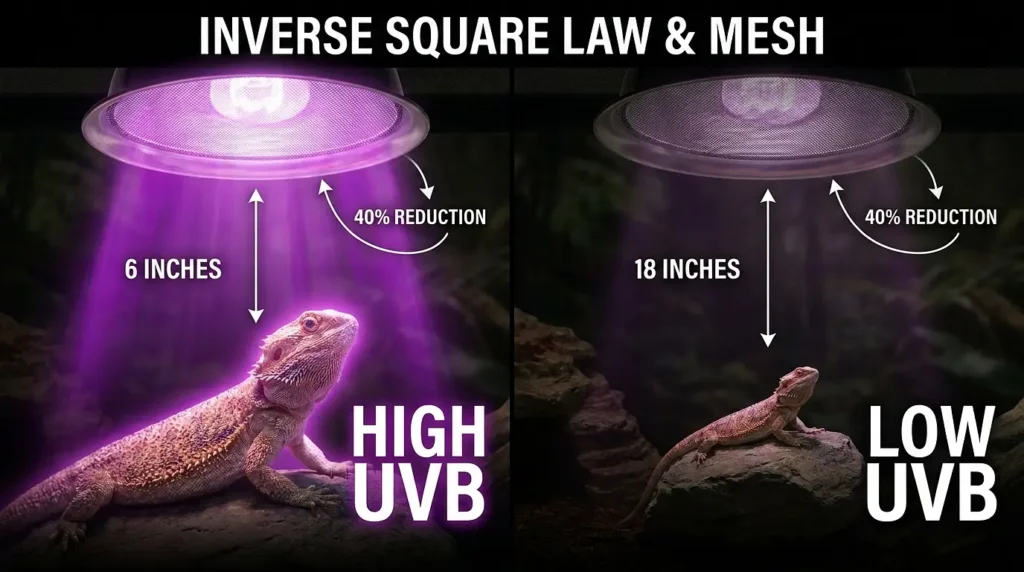
This is where most online advice falls apart. A number quoted with no distance attached is not information.
UVB intensity follows the inverse-square law, so doubling the distance reduces UVI by 75 percent. A bulb delivering correct output at 25cm delivers roughly a quarter of that at 50cm. The bulb has not changed. The geometry has.
Mesh compounds it. Screens block 30 to 50 percent of UVB, so a bulb mounted above a screen lid needs higher output or a lower mounting position to compensate. Guidance for bearded dragon setups commonly assumes around a 45 percent mesh block when calculating basking distances.
Three variables set the dose your animal receives: bulb output, distance, and what sits between them. Change any one and the reading changes.
What a Bearded Dragon Actually Needs
Bearded dragons are open-sun baskers, which puts them high on the Ferguson zone scale. Originating from Australia, they thermoregulate by exposing themselves to a UV Index of 2.9 to 7.4 during the day, placing them at the upper end of Ferguson Zone 3 with some individuals edging into Zone 4 during the hottest part of the day.
For captive setups, the target is a UVI of 4.0 to 4.5 in the basking area as measured by a Solarmeter 6.5, with a gradient running from 0 at the far end up to that basking figure.
One important exception. Bearded dragons with reduced pigmentation, including hypomelanistic, translucent, and scaleless silkback morphs, are likely to be more sensitive to high UVB and should not exceed a UVI of 3.0 in the basking area.
The gradient matters as much as the peak. The animal needs somewhere to go when it has had enough.
The Bulb Choices That Quietly Fail
Some setups never delivered adequate UVI even when the bulb was new, which means the decay problem was layered on top of an existing shortfall.
- Compact coil bulbs. These produce low, narrow-spectrum UVB that is insufficient for this species
- A 5.0 bulb for a desert animal. This is a tropical-reptile bulb. A bearded dragon needs 10.0 or 12 percent output, because 5.0 does not produce enough UVB at usable distances
- UVB through glass or acrylic. Glass blocks UVB entirely, so the dragon receives no benefit
- T8 in a large enclosure. T8 tubes must sit closer to the basking surface, usually within six to ten inches, and struggle to deliver adequate UVI at the basking zone in bigger enclosures
Unbranded imports are a separate risk. Testing has found products resembling established T5 kits that used a poor quality fixture and a tube which suffered rapid decay in UVB output.
The Signs That Appear Before the Obvious Ones
Insufficient UVB leads to metabolic bone disease, and MBD does not arrive suddenly. Early signs include subtle lethargy, reduced appetite, and occasional toe twitching. Advanced signs include a soft or rubbery jaw, bowed limbs, spinal deformities, inability to lift the body, and paralysis.
Veterinary guidance names the specific behavioural change worth watching for. Weak legs, a soft jaw, tremors, or difficulty climbing all raise the concern of metabolic bone disease, because without proper UV-B lighting dragons cannot absorb calcium effectively.
Difficulty climbing is often the first thing an owner notices. A dragon that has stopped using its branch, or hesitates before a hop it used to make without thinking, is worth taking seriously before anything visible appears.
There is a reason these signs get missed. Bearded dragons are prey animals and suppress visible signs of illness, so by the time symptoms are obvious the problem has often been building for a while.
Juveniles have less margin. A young dragon has less established bone mass, so the same deficiency depletes reserves faster, and deformities acquired during the growth phase become permanent skeletal features.
Why the Meter Is Worth Buying
There is exactly one way to know what your animal is receiving. The Solarmeter 6.5 is the only reliable instrument for accurately measuring UV Index at the basking surface, both for confirming adequate delivery and for identifying a failing bulb before it becomes a health problem.
It measures in the 280 to 400nm range, a spectrum that closely aligns with what reptiles need for D3 synthesis. The 6.5R model is operationally identical to the original but adds a Ferguson zone chart printed on the meter face for instant reference against the readout.
How to Use It Properly
- Measure at the animal’s back height on the basking surface, not at the substrate and not at the bulb
- Take readings across the enclosure at the basking spot, mid-tank, and cool end to confirm a genuine gradient
- Repeat monthly, taking measurements at reptile level rather than waiting for a problem to appear
- Log the numbers so you can see the decline rather than guess at it
Manufacturers categorise lamps by output at typical distances such as 30cm, using labels like Desert and Forest which cause a great deal of confusion. The label on the box describes a laboratory condition. Your enclosure is not that condition.
The Practical Position
If you do not own a meter, replace on schedule and do not negotiate with yourself about it. T5 at twelve months, T8 at six, mercury vapour at roughly 3,500 hours. Date the fixture when you install it.
If you do own a meter, the schedule becomes a backstop rather than the primary control. You will see the decline as it happens and replace when the reading drops below target rather than when the calendar says so.
Either way, the thing to stop trusting is your eyes. The bulb will look identical on the day it stops doing its job and on the day you finally swap it out. UVB fades long before brightness does.