

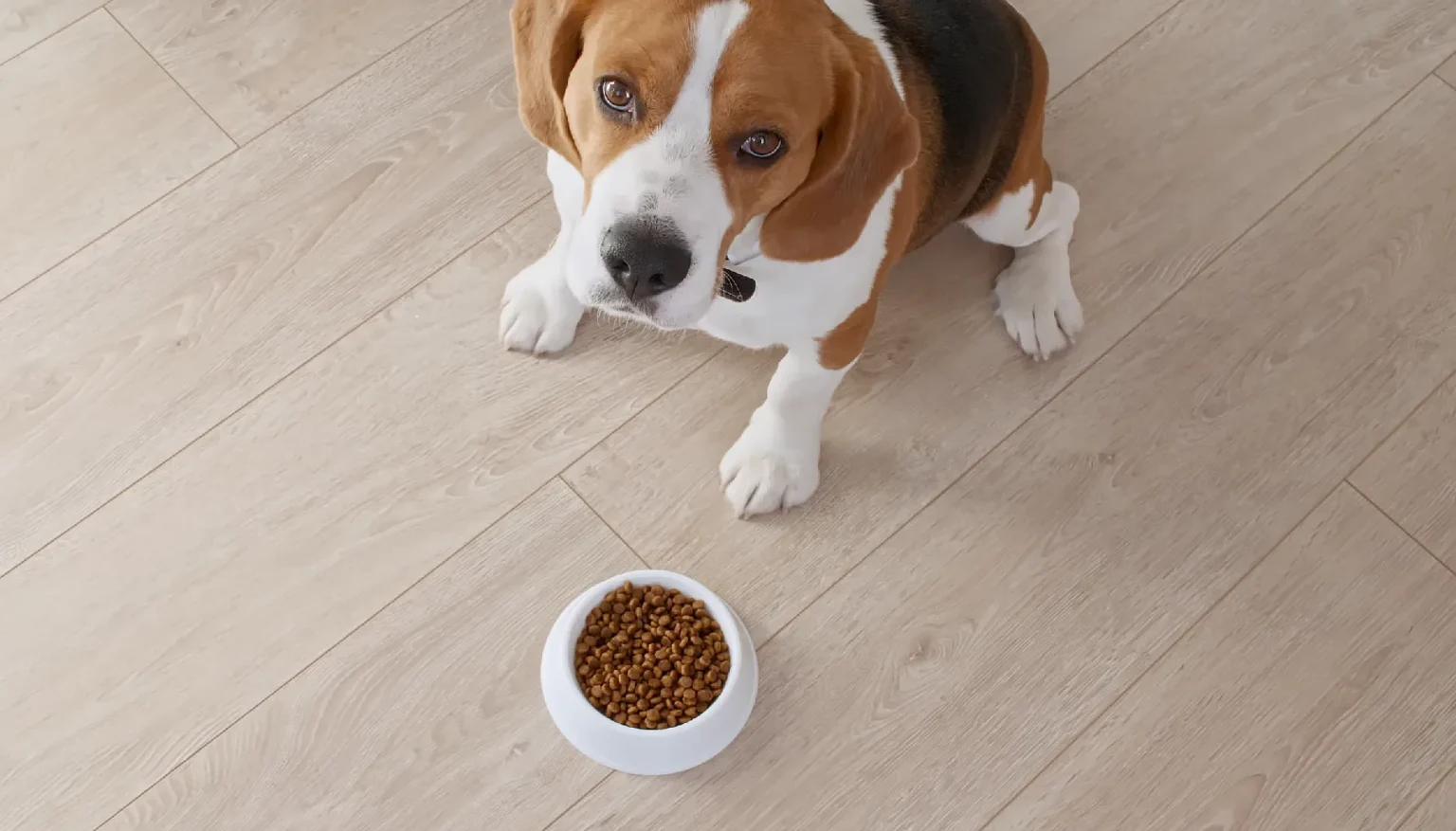
The number printed on the side of a dog food bag is not a prescription. It is a starting estimate built for an average dog that may look nothing like the one standing in your kitchen. For a large share of pets dogs, following that number exactly is the reason the vet keeps mentioning weight at every checkup.
The scale of the problem is not subtle. The Association for Pet Obesity Prevention puts the prevalence of overweight-to-obese dogs at roughly 60 percent of the pet population, close to human obesity rates. Its 2022 survey reported 59 percent of dogs as overweight. These are not dogs whose owners are careless. Most of them are being fed exactly what the packaging instructs.
The Guideline Was Built for a Dog That Has Not Been Neutered
This is the single largest gap between the bag and reality.
Purina Institute guidance states that caloric intake should be reduced by around 30 percent to account for lower energy needs after spaying or neutering effect, with further adjustments made to maintain a lean body condition. The reason is hormonal. After the procedure, reproductive hormone levels decrease and the basal metabolic rate drops by roughly 20 to 30 percent, so maintaining the same portions makes neutered dogs highly prone to accumulating excess fat.
Now look at what that means in practice. Most companion dogs in the UK, US, and Europe are neutered. The feeding guide on the bag does not ask you whether your dog is. It asks for weight, and sometimes activity level, and returns a range. A neutered dog fed at the printed figure is being fed for a metabolism it no longer has.
The clinical data supports this. A retrospective review of 438 veterinary records found that 47.12 percent of the neutered dogs assessed were in caloric excess, and that traditional predictive equations, including those designed for inactive or neutered dogs, tended to overestimate energy requirements.
Roughly half. Fed by the standard formula.
Wide Ranges Invite the Higher Number
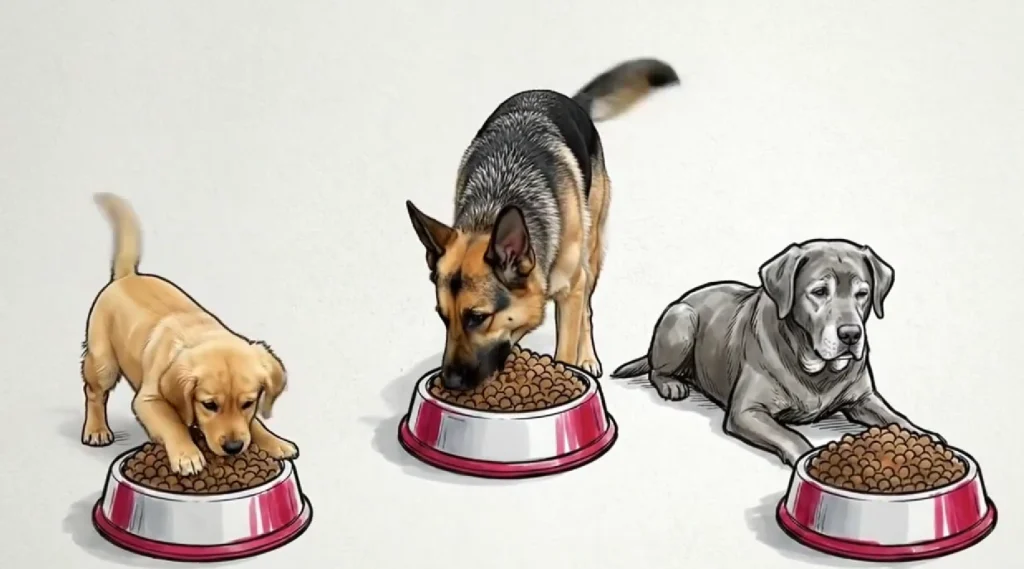
Feeding guides rarely give one figure. They give a band, often spanning several hundred grams across a single weight bracket.
Nobody feeds at the bottom of a range. Owners look at a hungry dog, see a range, and settle somewhere near the top. Over a year, the difference between the low and high end of a bracket is thousands of surplus calories.
Veterinary nutrition guidance is explicit that the packaging is not the authority. Feeding recommendations on the bag are a guideline rather than a rule. Body condition should sit at 4 to 5 on the 9-point Laflamme scale, with the dog weighed every two to four weeks and portions adjusted in 5 to 10 percent increments where there is deviation.
That is the actual method. The bag is where you begin, not where you stop.
Treats Are Not Counted Anywhere on the Label
The feeding guide assumes the food in the bag is the entire diet. In most households it is not.
Chews, training rewards, dental sticks, the crust of toast, the last spoon of yoghurt. None of it appears in the calculation printed on the packaging, and all of it lands on top of a portion that was already generous.
The standard recommendation is that rewards should make up no more than 10 percent of the daily ration. Crucially, that 10 percent comes out of the daily total, not in addition to it. If a dog is getting a tenth of its intake from treats, the bowl portion needs to come down by the same amount. Almost nobody does this.
The Scoop Introduces Error the Guide Never Accounts For
Feeding guides are written in grams. Most people measure with a cup.
Kibble density varies by shape, size, and formula, so a level cup of one food is not the same weight as a level cup of another. Add the fact that few scoops are ever properly level, and a small daily overestimate becomes a permanent one.
Weighing is the fix, and it costs almost nothing. A kitchen scale removes the largest source of daily portion error in the average household.
What Accurate Portioning Actually Looks Like
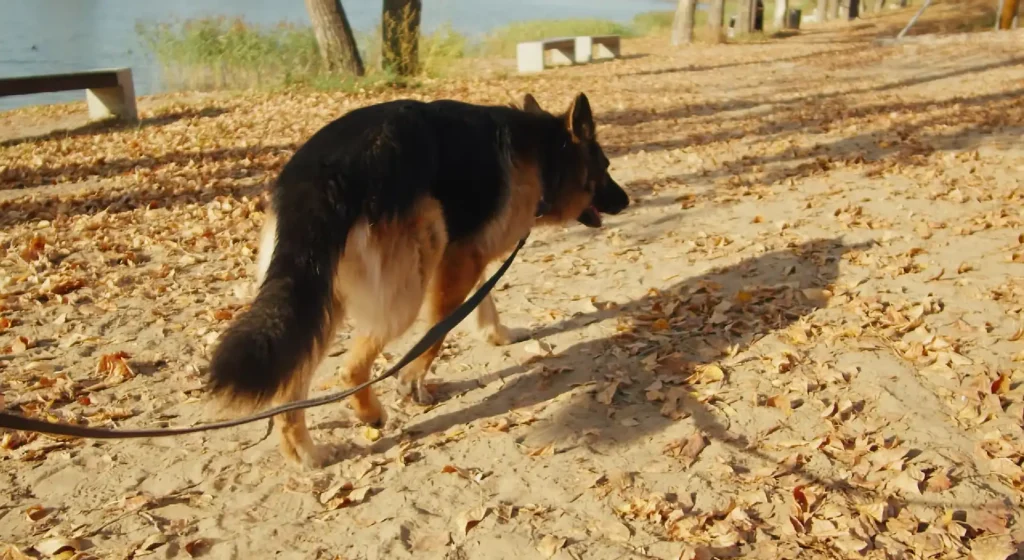
The calculation vets use starts from body weight and adjusts for the individual dog. Daily calorie needs are found by taking 70 multiplied by body weight in kilograms raised to the power of 0.75 to determine the Resting Energy Requirement, then multiplying by an activity factor ranging from 1.0 to 3.0 depending on whether the dog is neutered, a puppy, or a highly active working animal.
The activity factor is where the bag fails and where the real difference lies. A calm neutered dog sits at 1.2, a normally active dog at 1.4 to 1.6, an athletic dog at 2 to 3, and a puppy under four months at 3.
| Dog Type | Activity Factor |
|---|---|
| Calm, neutered | 1.2 |
| Normally active | 1.4 – 1.6 |
| Athletic / working | 2.0 – 3.0 |
| Puppy (under 4 months) | 3.0 |
A Practical Sequence
- Calculate the resting requirement from current weight, or from target weight if the dog needs to lose
- Apply the correct activity factor, being honest about how active the dog genuinely is
- Convert calories to grams using the kcal per kilogram figure on the packaging. Accurate caloric content prevents unintended overfeeding, though calorie information is only a required label element in the US and elsewhere may need to be requested from the manufacturer
- Subtract treat calories from that total rather than adding them on
- Weigh the portion rather than scooping it
- Score body condition and weigh the dog every few weeks, adjusting in small increments
One correction matters for dogs already carrying weight. For a dog that needs to lose, calories should be calculated on target weight rather than current weight, which establishes a safe deficit. Feeding an overweight dog to its current weight simply maintains the excess.
Why Owners Miss It
There is a perception problem sitting underneath the arithmetic. Studies show owners systematically underestimate their dogs’ weight, which is why body condition scoring provides an objective guide.
A dog at a body condition score of 6 or 7 looks normal to the person who sees it every day. It is not, and the consequences are not cosmetic. Research following dogs into later life found a mean body condition score between six and twelve years of age of 6.7 in the control-fed group against 4.6 in the lean-fed group, and showed that dogs did not have to reach obesity for quality of life to be significantly affected.
Being merely overweight was enough.
| Group | Mean Body Condition Score (ages 6–12) |
|---|---|
| Control-fed | 6.7 |
| Lean-fed | 4.6 |
The Practical Takeaway

Treat the printed guideline as the manufacturer’s opening suggestion for a dog that is intact, averagely active, and eats nothing else all day. If your dog is neutered, quieter than average, or gets treats, the real number is lower, often substantially.
Run the calculation. Weigh the food. Put your hands on the ribs every fortnight. Ribs should be palpable without pressure and the waist visible from above. That check tells you more than any number on a bag ever will.
Anything that changes the dog changes the number. Neutering, a new job that shortens the walks, an injury, the slow arrival of old age. The bag will keep saying the same thing regardless.